

Blog 06-2025 – Differences in fittings
Discover the versatile world of fittings in the maritime industry!
When building a vessel or vehicle, fittings play a crucial role in the design and construction of various systems and components.
Fitting components are widely used as connectors for piping, water, cooling water, fuel and hoses on board a boat or inside a vehicle, providing durability and reliability.
Methods
- Casting: Filling a mould with hot liquid.
Hot pressing: Shaping by means of heat and pressure.
Turning rod: Turning on a lathe for a smoother finish.
Most common types of fittings:
- Reducer / double nipple: Used to connect pipes or fittings.
Elbow: Used to create a 45° or 90° bend between pipework or fittings.
T-piece: Used to create a branch between pipes or fittings.
End cap: Used to close off a water pipe.
Socket: Used to connect two male-threaded pipe ends.
Hose tails and hose connectors: The simplest method for mounting a hose.
Couplings, connector nuts, reducer rings, thru-hull fittings and caps.
In this article, we will focus on three commonly used types of fittings in the marine industry: bronze fittings, brass fittings and CR fittings.
We will discuss the characteristics, applications and advantages of each type.
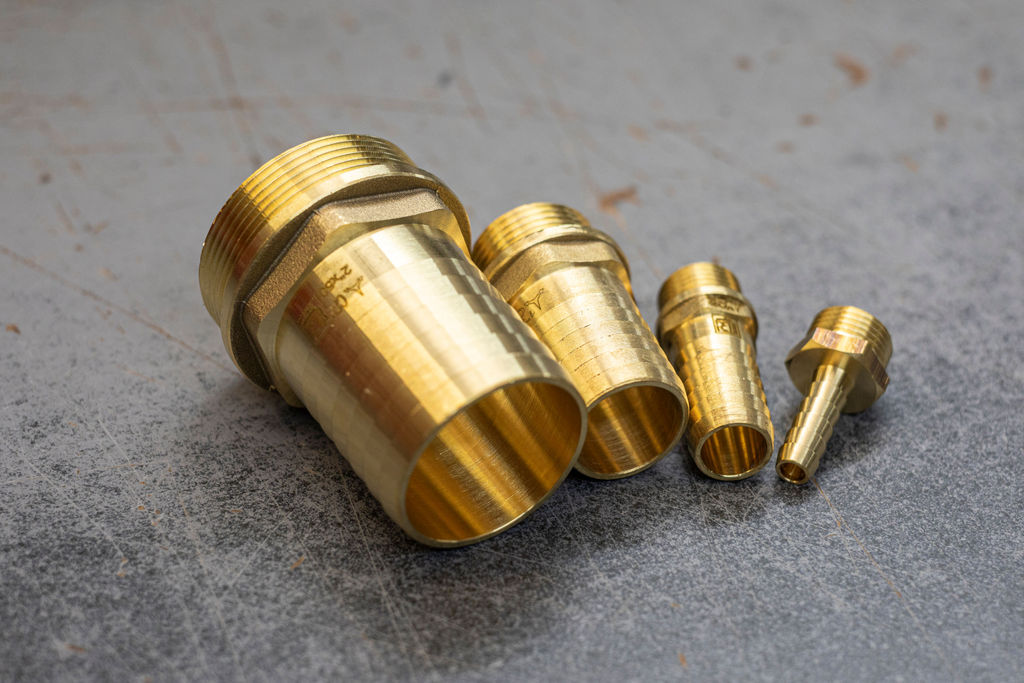
Bronze fittings
Bronze is an alloy consisting of copper and tin. It has been used in the maritime sector for centuries due to its durability and corrosion resistance. Bronze fittings are commonly used in systems where seawater comes into contact with components, such as cooling systems, pumps and valves.
Some advantages of bronze fittings include:
- Excellent corrosion resistance: Bronze is highly resistant to saltwater corrosion and has a longer lifespan than some other materials.
Strength: It is a strong alloy and in practice has the same working pressure as brass: 40 bar up to 1”, 25 bar from 1 1/4” to 2”, and 16 bar up to 5”.
Formability: Bronze is easy to process and can be shaped into complex forms.
Not protected against oxygen: Because the copper can come into contact with oxygen, a green oxide layer may form.
Brass fittings
Brass is an alloy of copper and zinc and is widely used in the maritime industry due to its good mechanical properties and aesthetic appeal.
Brass fittings are often used in interior and exterior applications on vessels, such as railings, handles and decorative elements.
Some advantages of brass fittings include:
- Corrosion resistance: Brass offers good resistance to corrosion in freshwater. In saltwater, however, zinc can dissolve.
Appearance: Brass has an attractive golden color and is often used for decorative purposes.
Machinability: Brass is easy to work with and can be milled, drilled and turned.
CR fittings (Corrosion Resistant)
CR fittings stand for corrosion-resistant fittings and consist of encapsulated zinc. They are widely used in the marine industry due to their excellent corrosion resistance and strength. CR fittings are commonly applied in environments with high corrosion exposure, such as hulls, exhaust systems and tanks.
Some advantages of CR fittings include:
- Corrosion resistance: Resistant to corrosion caused by seawater, chemicals and other aggressive environments.
Strength: CR fittings have high mechanical strength and can withstand significant pressure and stress.
Low maintenance: Requires minimal maintenance.
Our products are made from dezincification-resistant brass (CR), also known as DeZincification Resistant Brass or CR fittings, and are manufactured from a special alloy: CW602N.
Standard brass corrodes between 0.05 and 0.2 millimetres per year, whereas dezincification-resistant brass (CR) corrodes less than 0.02 millimetres per year.
Material rating (scale of 1 to 3):
Bronze
Freshwater: 3
Saltwater: 3
Durability: 3
Strength: 2
Formability: 3
Low maintenance: 2
CR fittings
Freshwater: 3
Saltwater: 3
Durability: 3
Strength: 2
Formability: 3
Low maintenance: 3
Brass
Freshwater: 3
Saltwater: 1
Durability: 2
Strength: 2
Formability: 3
Low maintenance: 2
(Maximum score is 3)
Based on this rating, we can conclude that each type of fitting has its own advantages and applications, depending on the specific requirements of the maritime project.
View
our range of fittings
Ask our experts
Our specialists are ready to advise you.
